INTRODUCTION
I
am always doing one or another type of genealogical research on the
internet. Often my genealogical research leads to historical
research. They seem to go hand in hand. For intsance, my genealogical
research led me to a bi and triracial isolate group called “the
Melungeons.” All the phoney research about the Melungeons led me
to research the Saponi Indians, which in its turn led me to the
Catawba, who were the largest of these eastern Siouan tribal groups.
I
have come to realize more and more about these people. They have
virtually dissapeared from history, but still live here amongst us,
often by mixed race people more Caucasian than Indian, or perhaps
more Negro, than Saponi. But what they and myself have in common is
the American Indian factor.
Why
did we dissapear as a full blood race? There are several factors. I
will call them “PLAGUES” as is the case in the Bible.
The
FIRST SIGN that something was about to change probably would have
gone undetected. This sign we would call EXPLORATION. It would have
consisted of explorers who charted the lands and peoples, studying
their strengths and weaknesses.
The
SECOND SIGN; would be the slave trade. First the groups in Virginia
vanished (all but a few hundred), by 1700. (25) The slave trade
drifted down to South Carolina, and would end with the end of the
Yamassee War before or about 1720. (26)
The
THIRD SIGN would be warfare. There were many wars, but the most
costly were the Tuscarora and Yamassee wars of about 1711-1717. After
the Tuscarora and Yamassee wars that ended before 1720, most of the
Southern bands had completely disappeared. Many of those who remained
moved in with the Catawba for safety.
The
FORTH SIGN was disease. A small pox epedimic killed half the
remaining Catawban peoples in 1738, and a second epedimic in
1759-1760 killed half again, leaving but a small remnant alive.
The
next step on the road to dissapearance, the FIFTH SIGN, was
assimilation. There were so few survivors of each of the bands, they
were forced to marry with both the Whites and Blacks.
Many
of those groups that remained in the East have since received state
recognition. There are the Monacan, Occoneechi, Sappony, Haliwa, and
Waccamaw. If I have missed some, please forgive me – contact me and
I'll edit it, and add. And of course there are the two better known
groups, the Catawba and Lumbee, who likely are descended from the
Cheraw, perhaps mixed with other bands that have disappeared. Like
the Phoenix, they have been granted a little kindling to see if they
could stir up the sacred fire once again.
But
for others, this opportunity has never manifested. From the 1850's
until the Allotment Act @ 1900, there were several government
promises of homes in Oklahoma for them, but later the government
renigged on everyone of them. Many have never been provided the
status of American Indian.
Some
tried to enroll as Cherokee for the alotment act, and were turned
down. There are similar groups in Ohio, Kentucky, Tennessee, and
elsewhere.
This
is pretty much the story of some of the people with mixed race
heritage found in the American Southeast and South Central states, in
whose hearts still burns a coal of remembrance of who their ancestors
were. I am hoping some of the things I write will keep the small
embers burning a little longer.
While
pondering these things, and studying them, I read that many died of
Small pox in 1759 during the French and Indian War. I also remembered
reading that British General Amherst has somehow decided to give
American Indians blankets carrying the Small Pox disease. As I read
about General Amherst, I also noticed that this occurred DURING THE
FRENCH AND INDIAN WAR! Was there a connection between the disease
contracted by the Catawba that almost ended the existence of the
tribe, and the actions of General Amherst? I wanted to find out.
That search is what this blog entry is about. Where do I start?
THE
FIRST TWO BATTLES FOR FORT DUQUESNE
In
everything I read about General Amherst, it mentions his use of “germ
warfare” occurred in and around Fort Pitt, and Fort Duquesne
preceeded Fort Pitt at this location. So I thought I'd start here.
The
war started over the French building forts along the Ohio River and
its tributaries. One such fort was Fort Duquesne, which was built
near the present city of Pittsburgh. It was built where the Allegheny
and Momongagahela Rivers unite to form the Ohio River. The British
made three attempts to take the fort. (1)
The
first attempt was in 1754. Christopher Gist was scout for George
Washington's Army. It was his Indian (Seneca/Mingo) reconniassance
that alerted George Washington that a French force under command of
Jumanville, was in the vicinity. Washington, with a force of 300 men,
surprized a French force in the area, and defeated them. Expecting a
counterattack, he hastily constructed Fort Necessity” nearby. His
Indian allies were Seneca, led by Chief Tanaghrisson, also called
“The Half King”.
As
Washington suspected, the French counterattacked a month later with a
superior force, and took Fort Necessity. They then burned it to the
ground. During this campaign Christopher Gist and George Washington
became friends, and Gist saved Washington's life.
The
next year, 1755 – a second attempt was made to conquer Fort
Duquense. British General Braddock was commander of this expedition.
Both Washington and Gist also were on this expedition. This time the
French and their Indian Allies surprized Braddock and his 1,200-1,400
soldiers. He along with 977 of his men were killed or wounded.
Washington survived. He is cedited with skillfully leading the
survivors to safety. Washington had convinced Braddick to take
Christopher Gist along, and Gist, once again, saved Washington's life
during this expedition.
The
third attempt to conquer this fort was successful, although it didn't
occur until 1758.. After two dismal failures, the English knew they
needed more American Indian allies. This led to efforts to give the
Southern Indians a more prominent role in these campaigns.
GAINING
THE HELP OF THE CATAWBAS
Records
exist of the help offered and given by the Cherokee, but in this
report. However I am interested in the Catawba. The following is a
direct quote from documents found online of these events, as they
relate to the Catawba. Governor Dinwiddie of Virginia sent his people
to contact with the Catawba and Cherokee. Below is an account of the
meeting with the Catawba. (3)
INTRODUCTION
His Honor the Governor having received several undoubted assurances of the sincere and hearty dispositions of the Catawba, and Cherokee Indians towards His Britannic Majesty's Subjects in general, and this colony in particular, and considered the great Importance of securing those war like nations to our Interest at this perilous juncture, when the French are laboring to seduce them from their fidelity to us, was pleased to propose in council the sixth of November last, That proper Commissioners should be sent as soon as possible to those Indians with an handsome present, and to conclude a firm and permanent league with them. Whereupon the council judging that no better use could be made of part of the money His Majesty had been graciously pleased to advance and send to his honor for the general service, unanimously agreed thereto. And Peter Randolph and William Byrd, Esquires, being nominated and approved of as gentlemen perfectly well qualified to conduct and carry into execution the proposed Treaties; they, in consequence thereof, having received his honor's letter, with his commission, and Instructions, and Speeches to the Chiefs of the said nations, proceeded immediately on their journey, and concluded the treaties and engagements, which are presented to the public in the following Sheets.
His Honor the Governor having received several undoubted assurances of the sincere and hearty dispositions of the Catawba, and Cherokee Indians towards His Britannic Majesty's Subjects in general, and this colony in particular, and considered the great Importance of securing those war like nations to our Interest at this perilous juncture, when the French are laboring to seduce them from their fidelity to us, was pleased to propose in council the sixth of November last, That proper Commissioners should be sent as soon as possible to those Indians with an handsome present, and to conclude a firm and permanent league with them. Whereupon the council judging that no better use could be made of part of the money His Majesty had been graciously pleased to advance and send to his honor for the general service, unanimously agreed thereto. And Peter Randolph and William Byrd, Esquires, being nominated and approved of as gentlemen perfectly well qualified to conduct and carry into execution the proposed Treaties; they, in consequence thereof, having received his honor's letter, with his commission, and Instructions, and Speeches to the Chiefs of the said nations, proceeded immediately on their journey, and concluded the treaties and engagements, which are presented to the public in the following Sheets.
King
HEIGLER
spoke
as follows,
“Brothers
and friends, at the request of my brother the Governor of Virginia, I
made him a visit last year. After much talk with him, I've treasured
up in my breast, and hope he has done the same, he told me that he
did not then want my assistance, but desired that I would hold my
warriors in readiness, not doubting, but that he should have occasion
for them soon. It was at the repeated requests of the Northern
Governors, that we concluded a peace with their Indians, which we
have hitherto strictly observed. But as the Shawnese and Delawares,
have broke the chain of friendship, between them and our brethern the
English, we think ourselves bound in gratitude to declare them our
enemies, and shall immediately take up the hatchet against them, and
you may be assured, never lay it down 'til we have sufficiently
revenged the Blood of our Friends. We have always been supplied, with
cloaths, guns and ammunition, by the Great King, on the other side of
the water, and have the most grateful remembrance of his kindness to
us, which has link'd us to his Interest with a chain stronger than
Iron. Our warriors delight in War, and our young Men are equally
pleased that they have an opportunity of going to Battle. It is my
resolution to lead them on whenever the Governor of Virginia thinks
proper.
"We
are in perfect Amity with the Cherokees, Cowetaws and Chickasaws. The
Cherokees have ever been our friends, and as they are a numerous
nation, we acknow|ledge them to be our elder Brother.
"WE hope they will shew a good example by sending a great number of their warriors to join us and our brethern of Virginia against the French and their Indian allies." Gave a belt of wampum.
"WE hope they will shew a good example by sending a great number of their warriors to join us and our brethern of Virginia against the French and their Indian allies." Gave a belt of wampum.
KING
Heigler,
then desired his warriors to speak for themselves, upon which . . .
Prenchee-Uraw,
spoke as followeth. Friends and brothers,"I am a young man, and
have not yet distinguished myself in war, but I am not a little
pleased, that I have an opportunity of doing it. If I should be so
fortunate as to do any Thing that deserves commendation, I shall have
the thanks of the great King George, and my brethern the English. But
whether I am successful or not, my endeavours shall be such as to
convince them of the Integrity of my intentions."
Chippapaw,
then rose up and spoke as follows; “Brothers, you have put a bright
hatchet in our hands, which we have accepted and hold fast. You have
also directed us where to strike it. I am determined, either to dye
it in the blood of our enemies, or to lose my life in the attempt."
Hixa-Uraw,
then spoke to the
following purpose; “Brothers, I have listened attentively to what the King and warriors have said. Their readiness in complying with your request, has given me great Pleasure, and as I have Feet as well as they, I shall not stay at home, if they are able to support me."
following purpose; “Brothers, I have listened attentively to what the King and warriors have said. Their readiness in complying with your request, has given me great Pleasure, and as I have Feet as well as they, I shall not stay at home, if they are able to support me."
THE
other Warriors present said
that the King and those who had already spoken had expressed their
sentiments, and that they were ready whenever they were called on to
hazard their Lives in Defence of their Brethern the English.
A
COPY of the ARTICLES
BE
it KNOWN to all those to whom these presents shall come, that the
honorable Robert Dinwiddie, Esquire, Lieutenant-Governor, and
commander in chief of the colony and dominion of Virginia, and
Arataswa King, Chupahaw, Prenchee-Uraw, Hixa-Uraw, Tannasee,
Yeaputkee, and Tooksesey, Sachems and Warriors of the brave Nation of
Catawba Indians, laying nothing more to Heart, than by new ies to
strengthen the good correspondence established between the subjects
of the King of Great-Britain, residing in North-America, and their
brothers and faithful allies the Catawba's, and to prevent, by
measures taken in time, the accidents that may excite a war, or cause
a disunion: The Honorable Peter Randolph, Esquire, one of His
Majesty's Council, Lieutenant of the county of Henrico, and
surveyor-general of His Majesty's customs, and the Honorable William
Byrd, Esquire, one of His Majesty's council, and Lieutenant of the
county of Lunenburg, on the Part and Behalf of the said Robert
Dinwiddie, Esquire, and the said Colony of VIRGINIA, and the said
Arataswa King, Chupahaw, Prenchee-Uraw, Hixa-Uraw, Tannasee,
Yeaputkee, and Tooksesey, Sachems and Warriors on the part and behalf
of the Catawba Nation, having full power, do treat, accord, and
conclude the following Articles.
I.
THAT the ancient alliance between the English and Catawbas be
renewed, and the old chain brightened.
II. THAT if the French King shall at any time wage war against the King of England, the Catawbas shall wage war with all their power against the French King, and all his Indian allies.
III. THAT the Catawbas shall march into Virginia, Forty or more able warriors, within forty days from the date of these presents, to such fort or place as the Governor of Virginia shall direct.
IV. THAT the men who shall be employed in the service of the English, in the colony of Virginia, as warriors, be found and provided with all necessary cloaths, victuals, arms and Ammunition.
Page 8V. THAT neither the Catawbas nor Virginians, shall protect the disobedient subjects of the other, or entertain rebels, traitors or fugitives, but within twenty days after due requisition made, shall deliver them up.
II. THAT if the French King shall at any time wage war against the King of England, the Catawbas shall wage war with all their power against the French King, and all his Indian allies.
III. THAT the Catawbas shall march into Virginia, Forty or more able warriors, within forty days from the date of these presents, to such fort or place as the Governor of Virginia shall direct.
IV. THAT the men who shall be employed in the service of the English, in the colony of Virginia, as warriors, be found and provided with all necessary cloaths, victuals, arms and Ammunition.
Page 8V. THAT neither the Catawbas nor Virginians, shall protect the disobedient subjects of the other, or entertain rebels, traitors or fugitives, but within twenty days after due requisition made, shall deliver them up.
VI.
THAT if any Subject belonging to the King of Great-Britain, residing
in Virginia, or any Indian belonging to the Catawba Nation, shall
offend against this treaty, they shall be punished, without the
treaty being any way thereby infringed.
Done and signed at the CATAWBA-TOWN, the 21st Day of February, 1756.
PETER
RANDOLIH. [L. S.]
WILLIAM
BYRD. [L. S.]
ARATASWA,
(mark) or HEIGLER. [L. S.]
CHU•AHAW,
(mark) [L. S.]
PRENCHEE-URAW,
(mark) [L. S.]
HIXA-URAW,
(mark) [L. S.]
TANNASEE,
(mark) [L. S.]
YEAPUTKEE,
(mark) [L. S.]
Tooksesey,
(mark) [L. S.]
With
the signing of the document above, the Catawba agreed to partake in
the French and Indian War.
THE
THIRD BATTLE FOR FORT DUQUESNE
In 1758. Generl
Forbes was given a force of 6,000 men with which to take Fort
Duquesne. Washington, then a Coonel, was also along on this
expedition. As for the Frenchmen, they only had a force of 200 men
inside the fort, and they knew their position was useless. Upon
arriving at the fort, Forbes American Indian scouts told him that the
french had abandoned the fort, and had chosen to burn it to the
ground. Forbes men soon built a new fort, and called it “Fort
Pitt”, about a thousand feet upstream.
It was completed
about 1761, and stood until after the end of the war. (4)
Records
about Fort Pitt are the ones that talk aout General Amherst and his
small pox infected blankets. However Fort Pitt didn't exist until
1761 and the Catawba Small Pox Epidemic was from 1759-1760. The years
don't add up, but the timing is still very close. Does one event
have anything to do with the other?
CHRISTOPHER
AND HIS SON NATHANIEL GIST
We
also know Chritopher Gist plays a significantrole in this story, and
now is the time to start discussing him in more detail. We have the
following from the family search website. (5)
Early
in 1755, when it was learned that Major General Edward Braddock was
on his way from England with troops and that a strong effort would be
made to recapture the western country, Gist was sent into the South
to invite the Cherokee and Catawba Indians to help drive the French
from their hunting grounds. Progress was slow but Governor Glenn of
South Carolina gave him some assistance and the Indians finally
promised to take part. As General Braddock approached Fort Cumberland
with his troops and no Indians were yet in sight, Governor Dinwiddie
sent Gist's son, Nathaniel, to hurry them along. Young Gist, who by
this time was quite well acquainted with Indian methods, was fairly
successful and had between four and five hundred ready to march, when
a certain Richard Pearis, a trader respected by the Indians,
belittled the young man's efforts. He represented to them that Gist
had no commission or presents and that one so young and of such
little importance would not be sent on such a mission if their
presence were greatly needed. Consequently Gist arrived at Fort
Cumberland without the Indians.
My
comment:
If
you look online, many of the descendants of these various “Nathaniel”
Gist's get them all entangled and mixed up together. Please remember
I have communicated with many professional genealogists, including
DNA administrators of the Gist surname at www.familytree.com.
The Nathaniel Gist mentioned in the previous paragraph is NOT the
same Nathaniel that I descend from. Christopher Gist and Nathaniel
Gist were brothers who each had sons named Nathaniel Gist. We descend
from Nathaniel, the son of Nathaniel. To make things more
complicated, MY Nathaniel (brother of Christopher) had a brother
named Richard, who had a son named Nathaniel. Richard and Nathaniel
(the brothers) both died at the Battle of Kings Mountain in the
Revolutionary War and they lived near one another to boot. Many Gist
researchers get all these Nathaniel's mixed up, confusing one for
another, and I can see why. If you are not EXTREMELY careful, you'll
get them mixed up as well. So we have Christopher's son, named
Nathaniel, visiting both the Cherokee and the Catawba. Meanwhile my
Nathaniel Gist Jr lived in Cumberland County, NC, just to the east of
the Catawba homeland.
Back
to the narative:
At
the same time, Washingt
on was relieved of Indian management and Edmund Atkin was appointed the king's agent to take charge of that service. Washington showed his friendship for Gist by sending him with a letter to Speaker Robinson urging an appointment for him in the Indian service. He wrote, "I know of no person so well qualified . . . He has had extensive dealings with the Indians, is in great esteem among them, well acquainted with their manners and customs, indefatigable, and patient . . . As to his capacity, honesty, and zeal, I dare venture to engage." Gist was subsequently appointed a deputy in the Indian service by Atkin. His duties were to distribute goods to the Cherokee and Catawba Indians and to continue soliciting their friendship. He was located at Winchester a greater part of the time and his dealings with the Indians occasionally led him into heated controversies with the highstrung governor. At one time he complained that he was retarded in his work because he did not receive the necessary confidence from his superiors. Dinwiddie replied with a letter outlining Gist's specific duties, in which he remarked :"I know not what You mean by the Country being troubled with an (6) Agent they cannot confide in." Gist continued faithfully in his appointed work during the remainder of 1757 and 1758. Sometime after Captain Gist's company in the regiment was disbanded, his son Nathaniel joined one of the other companies. In the early part of 1758 he was sent with six soldiers and thirty Indians to reconnoiter Fort Duquesne. After suffering great fatigue, occasioned by the snows of the Allegheny Mountains, the party reached the mouth of Redstone Creek, where Gist by a fall from a precipice was rendered unable to proceed. This caused a change in plans and the party separated. Three of the Indians descended the Monongahela River in a bark canoe till they came near Fort Duquesne, where they left their canoe and concealed themselves on the margin of the river till they found an opportunity of attacking two Frenchmen, whom they killed and scalped. These scalps were later brought to Fort Loudoun at Winchester by Ucahula, one of the Indians.
on was relieved of Indian management and Edmund Atkin was appointed the king's agent to take charge of that service. Washington showed his friendship for Gist by sending him with a letter to Speaker Robinson urging an appointment for him in the Indian service. He wrote, "I know of no person so well qualified . . . He has had extensive dealings with the Indians, is in great esteem among them, well acquainted with their manners and customs, indefatigable, and patient . . . As to his capacity, honesty, and zeal, I dare venture to engage." Gist was subsequently appointed a deputy in the Indian service by Atkin. His duties were to distribute goods to the Cherokee and Catawba Indians and to continue soliciting their friendship. He was located at Winchester a greater part of the time and his dealings with the Indians occasionally led him into heated controversies with the highstrung governor. At one time he complained that he was retarded in his work because he did not receive the necessary confidence from his superiors. Dinwiddie replied with a letter outlining Gist's specific duties, in which he remarked :"I know not what You mean by the Country being troubled with an (6) Agent they cannot confide in." Gist continued faithfully in his appointed work during the remainder of 1757 and 1758. Sometime after Captain Gist's company in the regiment was disbanded, his son Nathaniel joined one of the other companies. In the early part of 1758 he was sent with six soldiers and thirty Indians to reconnoiter Fort Duquesne. After suffering great fatigue, occasioned by the snows of the Allegheny Mountains, the party reached the mouth of Redstone Creek, where Gist by a fall from a precipice was rendered unable to proceed. This caused a change in plans and the party separated. Three of the Indians descended the Monongahela River in a bark canoe till they came near Fort Duquesne, where they left their canoe and concealed themselves on the margin of the river till they found an opportunity of attacking two Frenchmen, whom they killed and scalped. These scalps were later brought to Fort Loudoun at Winchester by Ucahula, one of the Indians.
comment:
At first I thought this was a Cherokee, and he probably is. I was
thinking of the Fort Loudoun down in the Cherokee Nation. But THIS
Fort Loudoun is up in Pennsylvania near Winchester, Virginia. I still
think he is probably Cherokee, but not as certain as I was.
Lieutenant
Gist at this time was reputed to be one of the most valuable scouts
on the Virginia and Maryland frontier. In June, 1758, he made his way
to join the Virginia Regiment at Fort Cumberland, where Colonel
Washington was collecting his forces preparatory to joining Forbes at
Raystown (Bedford). Captain Christopher Gist was also active in the
affairs of the camp at Raystown. After a strenuous effort he was able
to deliver to Colonel Bouquet a body of Cherokee Indians for the
campaign against Fort Duquesne. These Indians disappeared, however,
before the march began. Gist was with Forbes at the camp on September
3, 1758, but it is not likely that he accompanied the expedition. On
November 25 Nathaniel Gist marched with General Forbes into the ruins
of Fort Duquesne, and he may have been with Major Lewis at Grant's
disastrous defeat a short time before. It is certain (7) that Ensign
Thomas Gist took part in this memorable battle on Grant's Hill.
comment:
Thomas was another of Christopher's brothers. The Gist family were well represented in the French and Indian War.
Thomas was another of Christopher's brothers. The Gist family were well represented in the French and Indian War.
Thomas was wounded and taken prisoner by the Indians and was carried
into Canada. After a year of hardship he escaped, made his way back
to Virginia and rejoined his regiment. In a letter of December 31,
1758, to Washington from Captain Robert Stewart, written while the
latter was on duty at Fort Loudoun, the following is related : Last
night Lieu1 Gist, Sergeant Ostin (who Mr Gist got from the Indians)
and three men on Furloueh with Liberty to stay at this place only 3
days arriv'd here in 7 days from Pittsburg where Fort Barracks, &
Store Houses were erected, three Months Provisions laid in and three
Months more on the Road —this Fort is 120 feet in the interior
Square with four Bastions in each of which they have got a small
Mortar Mounted — the Barracks Form the Curtains and the Bastions
are Stockaded —the Duty there is hard and our Men suffer vastly for
want of Clothes —The Indians informs our people that 150 of the
French went down the River with the Cannon and 350 more (the
remainder of the Garrison) went up to Venango where they now are and
from whence (the Indians add) a Body of Troops will pay our Garrison
a visit whenever the River is open.
SOME
LETTERS TO AND FROM
GEORGE
WASHINGTON
CONCERNING THE CATAWBA
CONCERNING THE CATAWBA
In
searching for the Catawba during the French and Indian war,
1754-1763, I have found some information online in the George
Washington Papers. Although this was NOT material I thought I'd be
able to find, it is important, and I feel I should share it, as well.
I ran into a couple of things I wasn't expecting. A couple of
times a particular Catawba warrior might have been mentioned by name,
as were the Saponi and the Tuscarora. This had nothing to do with
discovering the origin of the small pox epedemic that ravaged the
Catawba, but it was of interest. So I have saved a small space to
mention more on these things.
To George Washington from Clement Read, 15 March 1757
From Clement Read Lunenburg March 15th 1757.
Dear Sir,
About 10 Daies agoe,
there came to my House twenty Six Indians of the Cawtaba Nation, with
two War Captains, Capt. French, or the French Warrior, and Capt.
Bullen, who I sent under the Care of Robert Vaughan to Williamsburg
where they desir’d to go before they March’d to you.
About five daies agoe, there came to my House 93 of the same Nation
with their King, Haglar, after they held a Council, it was
determin’d, that the King, with his Brother and Conjurer, shou’d
go to Wmsburg also, and that the others shou’d March directly to
you; Whereupon, as their Numbers were great, the Country thro’
which they were to pass thinly Inhabited, and as the Frontiers might
be frightned at such an Appearance of Painted Indians, I deem’d it
necessary to send a White Man along with them, And as Robert Vaughan
was gone with thee first 26, and as the Nation seem’d very fond of
him, I thought I might please them in sending his Brother Abraham
Vaughan with these to you, and they seem’d pleas’d that I did.
What I have to desire of you Sir, is, that you wou’d please to
Satisfie Mr Vaughan according to thee trouble he has taken & must
take, I need not inform you that they are a very troublesome set of
people, and their manner of travelling thro’ the Inhabitants, must
give their Guide a vast deal of trouble & fatigue,
And as from this Consideration, & the Necessity of Keeping
up a friendship with them, I have taken these Steps, in the Absence
of his Honour the Governor, which I hope may be approved of.
As from Information of these Indians, I every day expect, Capt.
Johnny Cawtaba & Mr Abraham Smith a Virginian,3 with
200 Cherokees and some more of the Catawba Nation which I must also
send a White Man with as a Guide I must hope, and take the freedom of
recommending to you, the paying of Mr Abraham Vaughan to his Content,
otherwise I have reason to fear, We shall hereafter get none to go on
this Slavish Service;
I need not add, but that I am, Dear Sir, Your unknown, but mo. Obedt
Hum. Servant,
Clement
Read
P.S.
I have given Abraham Vaughan twelve pounds ten shillings, all the
money I have, to assist him in Carrying on to Winchester. C.R. (22)
The
above mentions “Captain French” aka “The French Warrior” and
“Captain Bullen”. Mr. Read also mentions “There came too my
house 93 of the same nation with their king, Hagler. After a council,
it was determin'd that the kingwith his brother and conjurer, souuld
go to wmsburg also, and that the others should march directly to you
. . .
To
get this straight, ninety-three
catawba Warriors were to march directly to Col. Washington's command. There were already 26 Catawba present. That makes 119 total. There is also mention that hagler has a brother whom they call a “conjurer”.
catawba Warriors were to march directly to Col. Washington's command. There were already 26 Catawba present. That makes 119 total. There is also mention that hagler has a brother whom they call a “conjurer”.
To
George Washington from William Fairfax, 22 March 1757
I rec’d your Favor from
Philadelphia dated the 2d inst.since which finding the Governor
likely to stay there longer than at first expected and many
Matters of Government requisite which could not be done without Me I
set off from Belvoir and arrivd here the 17th The next Day I was duly
qualified in Council as President & Comander in Chief, which has
given Me an Opportunity of seeing and treating with Numbers of the
Cherokees & Catawba Indians,2 discuorsing
with Major A. Lewis & Lieut. Williams on their Affairs. I hope
They will soon be under your Command as They appear to be of a
warlike Temper and Disposition, fit & willing to encounter any
Difficult Attack. I shall be glad to know your Success with Ld
Loudoun and his Commands to You in the ensuing Campaign—Thô You
may hear of the Genl Assembly’s being prorogu’d to the last
Thursday in next Month, yet as several Things as well for your
Regiment as the public Weal of the Colony are wanted to be Examind,
Setled and adjusted, We expect the Governor will Soon after his
Arrival call & appoint a much earlier Meeting—when We shall be
glad to See You and give Testimony of our hearty Affection.
As the Cherokees and Catawba Indians appear to Us well attacht to
our Interest We are desirous of preserving Them, therefore endeavor
to please & satisfy them. We have furnishd them wth what could be
got here: what is yet wanted and you can procure Please to
accommodate them and Send or bring the Accot thereof.
Pray remember Me kindly
to yr Officers and the brave Men of yr Regiment, and continue to
believe that I am with all affecte Regards Dr Sir Yr assurd &
loving Friend
W. Fairfax
P.S.
I referr to Majr Lewis for pticulars.
comment:
The moral of both te Cherokee and Catawba warriors appears to be
high. It was written after the previous letter and before the next
one. (24) The next letter also mentions these same Catawba warriors.
From
George Washington to Robert Dinwiddie,
2 April 1757
2 April 1757
Honble Sir,
A letter which I received from Capt. Mercer, upon my return to
Alexandria, informs me, that 95 Cutawba’s, beside 25 that are gone
to Williamsburgh, are now in Winchester, waiting orders how to
conduct themselves1—That,
according to custom they are in want of matchcoats, shirts, leggings,
and all other necessaries. I shou’d be glad to receive your Honors
particular directions with respect to providing them with those
things, and in what manner they are to be employed: as I understand
they intend to accompany (in a body) any Troops of ours that may
march towards Du Quisne: Or, if no Expedition of that kind is
intended, then to go out in small scalping parties against the Enemy.
As your Honor gave me no particular directions concerning withdrawing
the Troops from Fort Cumberland, or how they are to be employed &
posted when relieved by the Marylanders; I shou’d be glad of orders
now also, whether I am to bring off all the Virginia Stores
(Provisions excepted) at the same time that the Indian Goods are
removed.
If your Honor does not choose to give particular directions
concerning the disposition of the Troops, but leave it to me; I shall
endeavour to post them in the most advantageous manner I can, until I
have the pleasure of seeing you; when this and many other affairs may
be fully settled. And I hope you will not think it advisable to order
any part of our small Regiment to march for Carolina, ’till the
Assembly meet and come to some determination about raising more, as
the consequences might be bad.
Notwithstanding I know it was
determined that only Forts shou’d be retained and that these were
fixed on; I shall not evacuate the others without orders as I know it
wou’d be attended with very ill effects. Nor do I think it
advisable that they should be dismantled just at this time. However,
in this as in all other points I only wait your Honors
determinations, to carry them into execution.
I set out immediately for Fort Loudoun, and from thence to Fort
Cumberland, if time will admit of it. I have ordered this Express to
proceed as soon as he receives your Honors Despatches to the former.
Governor Sharpe did not incline to give Captain Dagworthy orders to
march to Fort Cumberland, until you shall have given particular
Orders about withdrawing our Garrison—Therefore
the sooner I receive them the better. I shall be down by the 28th if
possible, & remain.
Your Honors,
Your Honors,
G:W
(23)
Here
the Catawba are still divided into 2 parties, one group of 25 in
Williamsbur and the other of 95. Earlier in mid March they were
divided into 2 groups, one of 26 and the other 93. So now there are
120 whereas before there were 119 Catawba 18 days ealier. It appears
that more Catawba participated in the French and Indian War than I'd
thought.
There
is a letter dated the 24th of April, 1757, from Captain
George Mercer detailing the Cherokees being upset because they didn't
receive the benefis they were told they'd receive. Mercer is worried
the same will happen with the Catawbas. An excerpt from his letter
reads:
“From
all this you see how necessary ’tis to have a proper Present immediately laid in for them. We may soon expect the Catawbas in too, who have an absolute promise of a present from me on their Return.7 If these Indians go home dissatisfied, we lose the Interest of the whole Nation. “
all this you see how necessary ’tis to have a proper Present immediately laid in for them. We may soon expect the Catawbas in too, who have an absolute promise of a present from me on their Return.7 If these Indians go home dissatisfied, we lose the Interest of the whole Nation. “
On
the 5th of June, 1758, Governor Dinwiddie stepped down,
and Francis Fauquier became Colonial Governor of Virginia. Attitudes
towards the American Indians changed.
CHANGE
IN INDIAN POLOCY
We
see a change in policy towards the Indians with a change in governors
of Virginia. Dinwittie knew he had to pay the Indians for their
support. Those payments wee not in money, but in rifles and
ammunition, in clothing, cooking utinsils, beads, et cetera, tings
they could not make themselves. They were not paid as they expected.
As a result, the Indians decide to leave. Perhaps this change in
policy would have occurred even if Dunwiddy had remained in office as
the Cherokee in the Spring of 1757 also were not given the same
“gifts” they expected, either, and Dundiddy was still governor at
that time. What ever the case, the English saw the Catawba's that
returned home diffrently. The following is from a ltter written July
4, 1758 by A. Boromsworth to George Washington.
“I
desire you'll be so good as forward the enclosed to Captn Gist that
he may not be imposed upon by a Scalp which Captn Johnny pretends to
have taken with his Catawbas. Colo. Bouquet is well convinced of the
Deceit & desires you will take Care Gist’s letter getts to
Winchester before Johnny can, The Circumstances are so strong against
him that they admit of no manner of doubt, therefore think he has
been sufficiently rewarded for the Service he has done us &
deserves not the least Countenance for such a Scandalous attempt. I
hope to have the pleasure of seeing you soon & am Dr Sr With
perfect regard Your most Obedient Humble Servtant,
A.
Bosomworth
my
Complts to Colo. Byrd &ca. Please to Seal Gists letter
comment:
Captain Johnny of the Catawba brought a small party of Catawba to Virginia for a time in the fall of 1756, and he also probably came with the party of Catawba who were in Williamsburg and Winchester in March–May 1757. He was certainly back in Winchester by May 1758, and on 1 June Captain Johnny and twenty-five Catawba marched with Adam Stephen and his troops from Winchester to Fort Loudoun in Pennsylvania. On 28 June Bouquet wrote Forbes: “This morning I sent off Captain Johny and his Catawbas to the Ohio, and gave them Lieut. [Colby] Chew of the Virginians, a very alert young man, with two other men. They have orders to try and take a prisoner, and to reconnoiter the enemy’s forces” (Stevens, Bouquet Papers description begins Donald H. Kent et al., eds. The Papers of Henry Bouquet. 6 vols. Harrisburg, Pa., 1951-94. description ends , 2:142–44). Presumably Captain Johnny returned from his mission with the suspect scalp. Bouquet wrote Forbes on 11 July that “the Catawbas have left us like scoundrels, after bringing us one scalp, which was recognized by the Cherokees as an old scalp which they themselves gave them in the spring”(16)
Captain Johnny of the Catawba brought a small party of Catawba to Virginia for a time in the fall of 1756, and he also probably came with the party of Catawba who were in Williamsburg and Winchester in March–May 1757. He was certainly back in Winchester by May 1758, and on 1 June Captain Johnny and twenty-five Catawba marched with Adam Stephen and his troops from Winchester to Fort Loudoun in Pennsylvania. On 28 June Bouquet wrote Forbes: “This morning I sent off Captain Johny and his Catawbas to the Ohio, and gave them Lieut. [Colby] Chew of the Virginians, a very alert young man, with two other men. They have orders to try and take a prisoner, and to reconnoiter the enemy’s forces” (Stevens, Bouquet Papers description begins Donald H. Kent et al., eds. The Papers of Henry Bouquet. 6 vols. Harrisburg, Pa., 1951-94. description ends , 2:142–44). Presumably Captain Johnny returned from his mission with the suspect scalp. Bouquet wrote Forbes on 11 July that “the Catawbas have left us like scoundrels, after bringing us one scalp, which was recognized by the Cherokees as an old scalp which they themselves gave them in the spring”(16)
The
Next Letter
There
is a second letter concerning this account;
From
George Washington to Francis Fauquier, 10 July 1758
To
Francis Fauquier
.
. .
. . . A Letter from Colo. Bouquet of
the 6th which I have just receivd Contains this Paragraph.
“The
Cuttawbas under the Command of Captn Johnne are gone to Winchester;
they have behav’d in the most shameful manner, and run away as a
parcell of thieves rather than Warriors without seeing me; they have
never killd a deer, and there is the strongest suspicians that the
Scalp they pretend to have taken, was an old one.
“I
think it woud be very necessary to send a message to their Nation to
complain of their Conduct, and know at once if they are Friends or
Enemies. if you approve of it, I shoud be obligd to you to propose
the thing to the Governor of Virginia: I write to General Forbes on
the subject.” (17)
Washington
writes back to Bouquet:
I
am sorry to hear that the Cuttawbas have so egregiously misbehavd
themselves—when I write to the Govr of Virginia which I expect may
be in a few days I shall touch on this Subject. I am Sir Yr most
Obedt Hble Servt
Go:
Washington (18)
Here
is an excerpt of that letter Washington promised to the governor.
A Letter from Colo.
Bouquet of the 6th which I have just received Contains this Paragraph.
“The Cuttawbas under the Command of Captn Johnne are gone to
Winchester; they have behav’d in the most shameful manner, and run
away as a parcell of thieves rather than Warriors without seeing me;
they have never killd a deer, and there is the strongest suspicians
that the Scalp they pretend to have taken, was an old one.
“I think it woud be
very necessary to send a message to their Nation to complain of their
Conduct, and know at once if they are Friends or Enemies. if you
approve of it, I shoud be obligd to you to propose the thing to the
Governor of Virginia: I write to General Forbes on the subject.”
(19)
The
new Virginia Governor Fauquier wrote back to Wasington the following
about the Catawba, and he is talkng about Indians in general --
“In Relation to Coll
Bouquet's paragraph about the Catawba’s I am not much surprized for
I have never entertain’d any high opinion of the friendship of any
Indians, nor form’d any great expectations from their service. As
for sending any messenger to them as he proposes I apprehend it will
be too late to under take any Thing of that sort for the benefit of
this campaign, and according to their behaviour in it, We shall be
better able to know what to say to them at the end of it. All that is
now to be done seems to me to be this, to keep those in good humour
who still remain with you, lest They should do mischief to the
inhabitants in their Return home (as some have done) if they leave
you in an ill humour. But as you have already wrote to General Forbes
on this subject. I shall readily acquiesce in any measure you shall
agree to be proper. (20)
coment: It is
obvious the new English Governor has no respect for the American
Indians. The difference in cultural expectations and norms was too
wide a gap to them to be able to bridge. In reading about Christopher
Gist, he kept saying the Governor's office didn't respect him or his
efforts. One can see this in their letters back and forth. Also
notice the opinion of Colonel Bouquet and Gov. Fauquier concernig the
Indians. As we shall see, Bouquet was of the same opinion concerning
the Indians as General Amherst. They both wanted to give the Indians
blankets that were full of the Small Pox contagen. We will get there
shortly.
A
pro-British alliance had previously been taking shape in southern
Appalachia that would lead more Cherokees to take part in the war.
Although some Overhills did go north earlier in 1757, many remained
skeptical of British promises and believed they should stay home to
hunt.
In
late August, 1757 in Chota, Overhill Cherokee capital, there was a
council taking place. Recall a few paragraphs back where in july
25th, 1757 Christopher Gist was named Superintendent of
Indian Affairs, Southern Divison. In September 1757 Christopher Gist
went himself to discuss with the Southern Indians, sending more
warriors to protect Virginia farmers and settlers on the frontier,
from the French and their Indian allies. Three Catawbas were invited
to talk with the Cherokee. A direct quote from the website above
says, “
“During
their Green Corn Ceremony [the Cherokee] heard three invited Catawba
give
a powerful war talk against the French. “The Creeks, Chickasaws,
Cherokees, Catawbas, Tuskeroras, Notowagas, the Sapony’s & the
Six Nations,” the Catawba dignitaries recited, “we are all
Brothers together & joined together against the French and the
Indians.” (12)
So
in 1757 in a letter to South Carolina Governor William Lyttleton,
there was a mention of the Saponi's participating in the French and
Indian War, as well as Tuscarora and Notowego's.
There
is one estimate that says the Catawba might have contributed between
three hundred and four hundred warriors to the English war effort. I
think that was probably a high estimate, but yet, it is there. (11)
I
finally found a reference saying Christopher Gist died July 27th,
1759, while on the road between Williamsburg and Winchester,
Virginia. There is another location saying he died on the 25th.
Somewhere it said there were 62 Catawba with him (13), but another
account says in April, 1758 there were 57 Catawba's amongst the
Southern Indian contingent (14). We have other accounts of 25 and 95.
They obviously sent different parties of warriors at different times.
By the 1756 treaty agreement they agreed to send 40, but sent far mor
than that amount. I suspect they rotated warriors like our military
does today.
CATAWBA'S,
TUSKERORA'S,
NOTOWAGA'S, AND SAPONY'S
NOTOWAGA'S, AND SAPONY'S
However
a short month after Colonel Bouquet and Gov. Fauquier have written
Wahsington back and forth degrading the Indian Warriors, we have
Washington lamenting the deaths of two Catawba warriors. we have
Washington writing the following letter:
https://founders.archives.gov/?q=Gist%20Catawba&s=1111311111&sa=&r=10&sr=
From George Washington to Henry Bouquet;
Camp at Fort Cumberland 24 August 1758
I
had the pleasure likewise of receiving yours of the 23d the Generals
happy recovery affords me vast Satisfaction, and am glad the New Road
turn’s out so much to your Liking.
The Convoy from
Winchester arrivd here yesterday in the Evening—they set out with
468 Beeves, 9 were killd on the Road and 411 were deliverd at
this place, the rest were lost on the Road; but as the Officer sent
immediately back after them we are in hopes the greatest part of them
will be found.
As
only 26000 lb. of Flour came up (which is not quite a Months
Provision’s for the Troops here) I have according to your orders
detaind it, likewise 90 Beeves, the rest sets out early to Morrow
Morning as does all the Forage except 60 Bushels of Corn.
When the Convoy got
within 6 Miles of this place 3 Cuttawba Men & 2 Squaws contrary
to the Advice of the Officers, set on before the Convoy for this
Garrison, and soon after were fired upon by about 10 or 12 of the
Enemy who Killd Captn Bullen and Captn French, & wounded one of
the Squaws. The loss we sustain by the death of these two Indian
Warriors is at this Juncture very considerable as they were very
remarkable for their bravery, and attachment to Our
Interest—particularly poor Bullen, whom (and the other) we buried
with Military Honours. The rest of the Cuttawbas, & what
Nottoway’s and Tuscarora’s that are here sets out to Morrow with
the Waggon’s for Rays Town.
As
we had Intelligence of several Parties of the Enemy being about I
detach’d Parties different way’s in hopes of coming up, or
cutting of the Retreat of some of them but without any effect—at
same time I reinforcd the Convoy with 50 Men.
There
are several Waggon’s which came up here with the Flour, that I am
at a loss what to do with.
Sergeant Scot
(mentiond in a late Letter)2 this
day returnd. He, when within 2 Miles of Fort Duquesne came upon a few
fresh Tracts making Inwards which he followd, apprehending that they
were just at hand, till his Provision’s were expended; and was
thereby obligd to return without making any discoveries worth
mentioning—I am glad Mr Chew & Mr Allan3 has
been able to give you Accts so agreable.
Captn
Woodward of the first Regiment 3 Subs. & 75 Rank & File
Marches tomorrow with 12 day’s Provision’s to waylay the Road in
the same manner as Captn McKenzie did.
Go:
Washington (21)
comment
one:
There
are a couple of interesting things here. First, notice it says “The
rest of the Cuttawba's & what Nottoways and Tuscarora's that are
here sets out tomorrow with the wagons for Ray's Town.” Assuming
the “Notowaga's” and “Notoway's” are the same people, then
their presence is confirmed, as they are now mentioned twice. The
same is true with the Tuscarora's. Only the Saponi's are mentioned
once. But they are mentioned with others that are present. They were
mentioned only by the Catawba's themselves. I suspect the Colonists
didn't mention them separately, because they probably travelled with
the Catawba and were considered a part of the Catawba contingent. It
is interesting that the Virginians mention the Nottaway and
Tuscarora, but not the Saponi. The Catawba mention all three.
Comment
two:
You
can't help but notice the two Catawba who were killed. It says 3
Catawba men and two women went ahead of the rest, and they were fired
on by 10 or 12 of the enemy, killing Captains Bullen and French, and
wounding a female. Only a month earlier the English were complaining
about the Catawba leaving the battlefield. The new governor and Col
Bouquet were writing back and forth about the Indians not being of
much value. But see what George Washington says about them. He says,
“When the Convoy got within 6 Miles of this place 3 Cuttawba Men &
2 Squaws contrary to the Advice of the Officers, set on before the
Convoy for this Garrison, and soon after were fird upon by about 10
or 12 of the Enemy who killed Captn Bullen and Captn French, &
wounded one of the Squaws. The loss we sustain by the death of these
two Indian Warriors is at this Juncture very considerable as they
were very remarkable for their bravery, and attachment to Our
Interest—particularly poor Bullen, whom (and the other) we buried
with Military Honours.”
Washington
had rgeat respect for the two catawba warriors. He said they were
“very remarkable for their bravery.” This doesn't sound like
“scoundrels” Bouquet called them.
There
is one more twist to this story. William
Byrd wrote Forbes on this day: “Some Indians that escaped affirm
they were Cherokees that did the Misschief; & ’tis probable
they were, as they left a Knife & a Spear in Bullen’s Body that
Captain Gist gave them, which he knew again” (Scottish Record
Office: Dalhousie Muniments).
(21)
One report says they were “fired upon” by 10 or 12 of the enemy.
But a second report, from the surviving Catawba (one male warrior and
two females) said they were fired upon by the Cherokee. Christopher
Gist said the knife and spear he had previously given the Cherokee
were found in Bullen's body. The author of this article says to this
conjecture, “tis probably they were.” Why would they take their
women with them? They thought it was safe. Perhaps this was some kind
of a revenge killing. These murders will probably remain a mystery
for all of time.
MORE
ABOUT THE INDIAN SERVICE
AND
THE DEATH OF CHRISTOPHER GIST
JULY
25, 1757: Christopher GIST, Esq., was appointed by Edmund ATKIN,
Superintendent of Indian Affairs in the Southern Department, as his
deputy in the colony of VA. GIST's duties were to be "upon the
Spot, not only to confer with (the Indians) from time to time, but to
direct them, their Conductors or Leaders, Interpreters, or others
having any concern with them. ... to Subsist and distribute Present
to them," and to fill any vacancies that might occur among his
hirelings. His first duty was to settle the Indian accounts, debts
which had been incurred by WASHINGTON and other officers in the VA
Regiment.
Sep
1757:
Edmund ATKIN and Christopher GIST left Winchester with an interpreter
to contact the Indians in the south and urge them to join the VA
Regiment in scouting parties to help protect the western settlements
against the French.
JULY
25, 1757: Christopher GIST, Esq., was appointed by Edmund ATKIN,
Superintendent of Indian Affairs in the Southern Department, as his
deputy in the colony of VA. GIST's duties were to be "upon the
Spot, not only to confer with (the Indians) from time to time, but to
direct them, their Conductors or Leaders, Interpreters, or others
having any concern with them. ... to Subsist and distribute Present
to them," and to fill any vacancies that might occur among his
hirelings. His first duty was to settle the Indian accounts, debts
which had been incurred by WASHINGTON and other officers in the VA
Regiment.
Sep
1757: Edmund ATKIN and Christopher GIST
left Winchester with an interpreter to contact the Indians in the
south and urge them to join the VA Regiment in scouting parties to
help protect the western settlements against the French.
Some
of the officers of the Virginias Regiment wrote letters to Washington
expressing their regret at his resignation of the command. He had
resigned after the victorious third, and last, attempt to take Fort
Duquesne, at the end of 1758. (25)
Washington
had hoped to receive a commission in the English Army because of his
valuable service. Then this did not happen, he resigned his Colonial
Commission from the state of Virginia. However after reading some of
Washington's letters I found online, I suspect he also didn't like
the tone of the new governor of Virginia. He and Gist had worked long
and hard to get the support of the Southern Indians, and the new
governor and many of the principle officers just blew that off as a
waste of time. They didn't like the Indians, and really didn't care
if they helped or not.
As late as September 16, 1759, Colonel George Mercer, then at
Winchester, speaks of [Christopher Gist]. A little later we hear of
him for the last time. Captain Robert Stewart, serving at Fort Pitt,
after describing to Washington in a letter of September 29, 1759, the
beauties of the newly captured country, inquired, "what Steps
have been taken in securing to us, those Lands which poor Capn Gist
was to have entered for us, I hope the needfull is done, they surely
will soon be very valueable." Until this time his name is
referred to frequently in correspondence of the French and Indian
War. After this the references cease and his name cannot anywhere
again be found. It is said by different writers that he died about
this time in North Carolina or Virginia of smallpox.
The
late John Ritenour made some attempt to locate the place of his
burial but without success. In November, 1762, the "Administrators
of... Christopher Gist, deceased," petitioned the Virginia
assembly for six hundred pounds due Gist for service in Indian
affairs. (10)
My
comment: You might wonder why I am spending so much time on the
Gist's, and think perhaps I am researching because of a curiosity
about some of our relatives. Well, that got my attention as well –
but there is far more. Christopher was assigned to work with the
Indian Service, and aided in seeing to it that the Cherokee and
Catawba were well supplied and provisioned. Christopher Gist died,
and part of thhis record is an attempt to discover the exact date of
his death. In a letter from Capt. Stewart to Col. Washington,
mentions “poor” Capt. Gist, as though he has died, dated
Septembre 29th, 1759. The relevance of this information
will shortly be made clear.
Edmund
ATKIN left the colony and gave GIST a number of instructions and
ordered him to keep him informed of the VA situation. He instructed
GIST to establish two stations in the VA frontier, one at Winchester,
where he was to be stationed, and the other at the head of the
Roanoke River. Vance's
note:
If you look at the city of Roanoke on a map of Virginia, the Roanoke
River floes right through it. There is a town called “Catawba”
maybe 10 miles to the northwest.] The Indian scouting parties, raised
among the Cherokees and Catawbas, were to assemble at these stations,
be fitted for war, and after their period of service was over, to be
given presents promised by ATKIN and his agents in the south who had
hired them.
This
article continues with Indians ariving in Winchester in Northern
Virginia for the fall 1758 campaign. Gist knows the Cherokee were
promised certain things which the English ignored, and therefore the
Cherokee plunder neighboring farms and return home. It does go on to
say “Forbes had only a few Cherokees and a few Catawba's . . .”
for his 1758 campaign to retake Fort Duquesne.
Now
we come to Captain Gist's death :
1759:
During the early part of the year, GIST was busy sending Indian
scouting paries out to guard the VA frontier. The French continued to
send raiding parties of Indians against the English settlements,
where they killed and took many Englishmen and women as prisoners.
GIST was successful in buying back some of the prisoners.
1759,
25 Jul: At the time of his death from smallpox, he was conducting 62
hand-picked Catawba warriors to Winchester to help guard the western
frontier of VA. (2tt) Died intestate.
1759,
12 Aug: Col. George MERCER met the Catawba warriors near Winchester
and urged them to go on and join the VA troops, but they said their
Father Capt. GIST was dead and it was better to return home. (15)
1762,
Nov: The administrators of the estate of Christopher GISt petitioned
the VA Assembly for L600 due GIST for services in Indian affairs.
Comment:
So
it was the duty of the Catawba and Cherokee to discover information
about the movements of the French and Indians on the Virginia
frontier, and prevent them from attacking the farms and towns found
there.
However
the major reason I started researching and sharing all of this is
that it is stated that Captain Christopher Gist died of small-pox
while conducting sixty-two Catawba Warriors to Winchester in 1759.
Another reference said they were going from Williamsburg, Va. To
Winchester. The next entrance says Col. George Mercer (who was Capt.
Gist's commanding officer) met with these Catawba to convince them to
remain. Their response is that “Their Father”, Capt. Gist, died
and that it was best for them to return home.
So
the young Catawba Warriors called him “Father.” Much is written
about the Gist's relationship with the Cherokee, but his relationship
with the Catawba is seldom mentioned. The term “Father” is a term
of friendship, respect and honor.
They'd
seen small pox before. In 1738 a small pox epedimic wiped out half of
the Catawba Nation. The young men of the Catawba Nation might not
remember much about the the 1738 epedimic, their elders did. They
wanted to get away from there as fast as they could. It did not help.
It is said that in 1759-1760 that half of the Catawba Nation died of
Small Pox. This gets me back to General Amherst. What exactly was he
doing? Was any responsibility for the deaths of the Catawba due to
the Smaill Pox his responsibility?
THE
SMALL POX
CORRESPONDENCE
BETWEEN
BOUQUET AND AMHERST
BOUQUET AND AMHERST
What
exactly did Lord Jeffrey Amherst do? He was once well respected, a
college was named after him. Who was he? The web site above says this
about him:
Lord
Jeffery1
Amherst was commanding general of British forces in North America
during the final battles of the so-called French & Indian war
(1754-1763). He won victories against the French to acquire Canada
for England and helped make England the world's chief colonizer at
the conclusion of the Seven Years War among the colonial powers
(1756-1763).
The
town of Amherst, Massachusetts,
was named for Lord Jeff even before he became a Lord. Amherst
College was later named after the town. It is said the local
inhabitants who formed the town preferred another name, Norwottuck,
after the Indians whose land it had been; the colonial governor
substituted his choice for theirs. Frank Prentice Rand, in his book,
The
Village of Amherst: A Landmark of Light [Amherst,
MA: Amherst Historical Society, 1958], says that at the time of the
naming, Amherst was "the most glamorous military hero in the New
World. ... ...the name was so obvious in 1759 as to be almost
inevitable." [p. 15]
comment:
Hmmm . . . It says he [Jeffrey Amherst] was a “glamerous hero” and says that this was obvious in 1759. That is the year our Christopher Gist dies, and the year of the Catawba Holocaust, the year the Small Pox devastated the tribe. Was he responsible for the deaths of many of the English Indian Allies? Let's go on.
Hmmm . . . It says he [Jeffrey Amherst] was a “glamerous hero” and says that this was obvious in 1759. That is the year our Christopher Gist dies, and the year of the Catawba Holocaust, the year the Small Pox devastated the tribe. Was he responsible for the deaths of many of the English Indian Allies? Let's go on.
Smallpox
Blankets
Despite
his fame, Jeffery Amherst's name became tarnished by stories of
smallpox-infected blankets used as germ warfare against American
Indians. These stories are reported, for example, in Carl Waldman's
Atlas
of the North American Indian
[NY: Facts on File, 1985]. Waldman writes, in reference to a siege of
Fort Pitt (Pittsburgh) by Chief Pontiac's forces during the summer of
1763:
... Captain Simeon Ecuyer had bought time by sending smallpox-infected blankets and handkerchiefs to the Indians surrounding the fort -- an early example of biological warfare -- which started an epidemic among them. Amherst himself had encouraged this tactic in a letter to Ecuyer. [p. 108]
Some
people have doubted these stories; other people, believing the
stories, nevertheless assert that the infected blankets were not
intentionally distributed to the Indians, or that Lord Jeff himself
is not to blame for the germ warfare tactic.
Comment:
Well, it doesn't seem to have anything to do with the disease that killed half of the Catawba in 1759 and 1760. That still isn't very comforting, but it seems to be the fact. Chief Pontiac is mentioned. Fort Pitt, built near the ruins of the French Fort Duquesne, was the location. Chief Pontiac was a war chief of the Ottawa, a Canadian Great Lakes tribe. He besieged Fort Pitt. What happened next?
Well, it doesn't seem to have anything to do with the disease that killed half of the Catawba in 1759 and 1760. That still isn't very comforting, but it seems to be the fact. Chief Pontiac is mentioned. Fort Pitt, built near the ruins of the French Fort Duquesne, was the location. Chief Pontiac was a war chief of the Ottawa, a Canadian Great Lakes tribe. He besieged Fort Pitt. What happened next?
Lord
Jeff's letters during Pontiac's Rebellion
The
documents provided here are made available to set the record
straight. These are images of microfilmed original letters written
between General Amherst and his officers and others in his command
during the summer of 1763, when the British were fighting what became
known as Pontiac's
Rebellion.
Pontiac,
an Ottawa chief who had sided with the French, led an uprising
against the British after the French surrender in Canada. Indians
were angered by Amherst's refusal to continue the French practice of
providing supplies in exchange for Indian friendship and assistance,
and by a generally imperious British attitude toward Indians and
Indian land. As Waldman puts it:
... Lord Jeffrey Amherst, the British commander-in-chief for America, believed ... that the best way to control Indians was through a system of strict regulations and punishment when necessary, not "bribery," as he called the granting of provisions. [p. 106]
The British Manuscript Project
The
documents provided here are among Amherst's letters and other papers
microfilmed as part of the British Manuscript Project, 1941-1945,
undertaken by the United
States Library of Congress during World War II. The project was
designed to preserve British historical documents from possible war
damage. There are almost three hundred reels of microfilm on Amherst
alone.
The
microfilm is difficult to read, and paper copies even harder.
Nonetheless, the images obtained by scanning the copies are
sufficiently clear for online viewing. The images are of key excerpts
from the letters. An index is provided to show by microfilm document
number the location of the imaged documents in the microfilm set.
Text files of the excerpts are also provided.
Comment:
Okay, they've got me curious. What do these documents say?
Okay, they've got me curious. What do these documents say?
Well
he goes on to say evidence consists of two mail letters. One a letter
from Colonel Henry Bouquet suggesting the British distribute blankets
“to inoculate the Indians” and the second a message from Amherst
approving of Bouquet's suggestion. Amherst suggests "to try
Every other method that can serve to Extirpate this Execrable Race."
Amherst suggest using “the Spanish method” which is the usage of
dogs. The narative continues:
Historian
Francis Parkman, in his book The
Conspiracy of Pontiac and the Indian War after the Conquest of Canada
[Boston: Little, Brown, 1886] refers to a postscript in an earlier
letter from Amherst to Bouquet wondering whether smallpox could not
be spread among the Indians:
Could it not be contrived to send the Small Pox among those disaffected tribes of Indians? We must on this occasion use every stratagem in our power to reduce them. [Vol. II, p. 39 (6th edition)]
I
have not found this letter, but there is a letter from Bouquet
to Amherst, dated 23 June 1763,
[189k] three weeks before the discussion of blankets to the Indians,
stating that Captain Ecuyer at Fort Pitt (to which Bouquet would be
heading with reinforcements) has reported smallpox in the Fort. This
indicates at least that the writers knew the plan could be carried
out.
It
is curious that the specific plans to spread smallpox were relegated
to postscripts. I leave it to the reader to ponder the significance
of this.
Several
other letters from the summer of 1763 show the smallpox idea was not
an anomaly. The letters are filled with comments that indicate a
genocidal intent, with phrases such as:
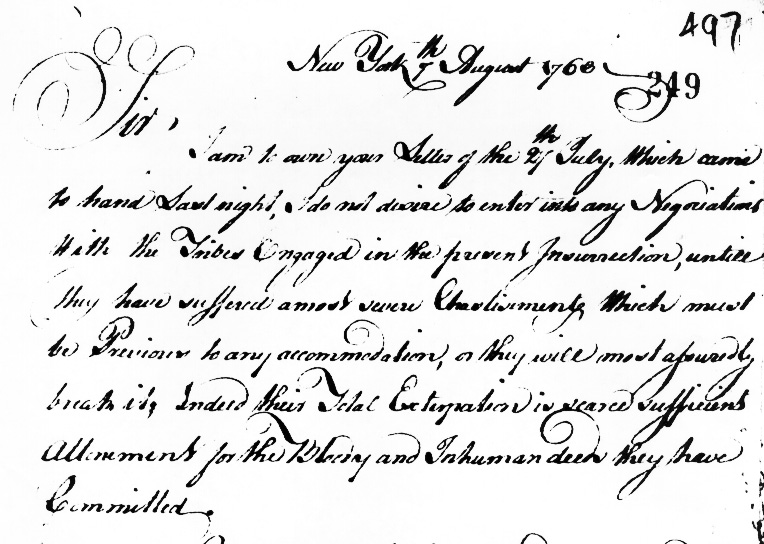
- "...that Vermine ... have forfeited all claim to the rights of humanity" (Bouquet to Amherst, 25 June) [149k]
- "I would rather chuse the liberty to kill any Savage...." (Bouquet to Amherst, 25 June) [121k]
- "...Measures to be taken as would Bring about the Total Extirpation of those Indian Nations" (Amherst to Sir William Johnson, Superintendent of the Northern Indian Department, 9 July) [229k]
- "...their Total Extirpation is scarce sufficient Attonement...." (Amherst to George Croghan, Deputy Agent for Indian Affairs, 7 August) [145k]
- "...put a most Effectual Stop to their very Being" (Amherst to Johnson, 27 August [292k]; emphasis in original).
Amherst's
correspondence during this time includes many letters on routine
matters, such as officers who are sick or want to be relieved of
duty; accounts of provisions on hand, costs for supplies, number of
people garrisoned; negotiations with provincial governors (the army
is upset with the Pennsylvania assembly, for example, for refusing to
draft men for service); and so on. None of these other letters show a
deranged mind or an obsession with cruelty. Amherst's venom was
strictly reserved for Indians.
In
the Spring of 1763, had met with a Delaware Chief. The Delaware
demanded the surrender of the fort, and in response the English
commander, who happened to be a Suiss mercenary named Simeon Ecuyer,
provided them with two blankets and a handkerchief. It was written
that by mid July the Delaware were dying at an alarming rate of Small
Pox. That is about the same time as Bouquet and Amherst were writing
letters to one another, back and forth, about using Smaill Pox a germ
warfare.
What
can I conclude? Did the English provide blankets to their Indian
allies as well as their enemies? Did they intentionally give spall
pox to the Catawba? Evidence suggests no. It also killed an up and
coming officer, Captain Christopher Gist, a friend of George
Washington. However I do suspect they knew how to infect the Indians
with the disease. They had seen the effect the disease had on tribes
such as the Catawba.
Several
horors came down upon the Catawban peoples like the Biblical plagues
of old. First
Explorers studied the lands and people for weaknesses they could
exploit. Second
came slave raids. The Third
was warfare. After the Tuscarora and Yamassee wars most of the bands
had gone. And Fourth,
came disease. But the real end of the people is that they became
forgotten, absorbed, and assimilated. There are actually websites and
groups that state some of the Indians were Jews brought over by the
Dutch. Others say these mixed race people are Portuguese. Such
portrayals are the biggest insults of all. The fifth
horror is denial of the truth. They negate our right to be who we
are. If you want to be Portuguese or Hebrew, fine, maybe you are! But
there is not a bone of MY body that is either of those nationalities.
This is the final nail in the coffin,
After
the French and Indian War, they were a mere shadow of their former
selves. This was followed up not by extinction, but rather
assimilation. There are thousands of people today walking around with
Catawban and Eastern Siouan blood in their veins. Some think they are
mixed-Cherokee, or Jewish, or Portuguese, or some even say Turkish.
Instead of extinction there is that long lingering memory. Our
ancestors WANT to be found, but there are traps and roadblocks
everywhere. This makes them very difficult to find.
Maybe
I'd hoped Amherst and Bouquet were monsters – but they were
products of their time. Many felt just like them. If we could be a
name to blame and a shadow to hate. But rarely is it that simple. I
don't know, I just wanted to learn, to do research. Any time you
shine a torch into the darkness you find something and if you share
it others can find it too. I guess that's all I've done.
Sources:
(3)
http://quod.lib.umich.edu/e/evans/N06056.0001.001/1:1…
Even
though the link as you can see, is "cut short", I used the
"copy" and "paste" feature on my computer, and
this link still came up. Computer sources make terrible links,
because they are often moved from location to another. I hope to get
more reliable citations when I can.
(4)
http://www.mountvernon.org/digital-encyclopedia/article/forbes-expedition/
(5) https://familysearch.org/photos/artifacts/31812100?signin=true&reportabuse=true
(5) https://familysearch.org/photos/artifacts/31812100?signin=true&reportabuse=true
(6)
Hamilton, Letters to Washington, 1-.270, 272, 301; Washington,
Writings, 1:372 (Ford edition). 47 Dinwiddie, Official Records,
2:622; Washington, Writings, 1:442, note 1 (Ford edition). 48 George
Washington, Writings, 2:236 (edited by Jared Sparks — Boston,
1834). LAWRENCE A. ORRILL Aug.
(7) Virginia
House of Burgesses, Journals, 1761-65, p. 103 (edited by John P.
Kennedy —Richmond, 1907) ;Dinwiddie, Official Records, 2:671, 707,
708, 713; Hamilton, Letters to Washington, 2:215, 244, 260. 60
William A. Crozier, ed., Virginia Colonial Militia, 1651-17J6, 27
(New York, 1905); Washington, Writings, 2:283 n. (Sparks edition);
Hamilton, Letters to Washington, 2:334. 1932 CHRISTOPHER GIST 215
(8) Hamilton,
Letters to Washington, 2:362; 3:79; Virginia House of Burgesses,
Journals, 1761-65, p. 52, 175. Gist's name appears as "Guest"
in the list of officers of the First Virginia Regiment killed or
missing. Olden Time, 2:28s (June, 1847). 52 Hamilton, Letters to
Washington, 3:148. 53 This is a little nearer an exact date than
heretofore calculated. Neville B. Craig states that it was "probably
about the 1st of January, 1759." History of Pittsburgh, 66. 54
Hamilton, Letters to Washington, 3:143; Olden Time, 1:195 (May,
1846). 216 LAWRENCE A. ORRILL Aug.
(9)
Virginia Magazine of History and Biography, 5:173 (October, 1897);
Hamilton, Letters to Washington, 3:159, 165.
(10)
Virginia House of Burgesses, Journals, 1761- 65, l>- 136.
(11)
http://www.appalachiancherokeenation.net/images/The_British_and_Indian_War_Cherokee_Power_and_the_Fate_of_Empire.pdf
;
With three hundred to four hundred warriors, the Catawbas played less
of a role in influencing the outcome of events in the Ohio Valley.
For an analysis of eighteenth-century estimates of Native population
numbers, see Peter H. Wood, “The Changing Population of the
Colonial South: An Overview by Race and Region,
(12) Paul Demere to William Henry Lyttelton,
Oct. 11, 1757, Lyttelton Papers
(13)
http://image.vtls.com/colonial/virtua-basic.html Christopher
Gist died 7-25-1759 of smallpox while guiding Catawba warriors
to Winchester to guard the frontier against the French and other
Indians.
(14) The British’s April count included 57
Catawbas as well, bringing the total number of “southern Indians”
to 652; see “A Return of the Southern Indians,” Apr. 21, 1758,
Headquarters Papers of Forbes, reel no. 1, item 132. John Forbes gave
his estimate in Forbes to John Campbell, 4th Earl of Loudoun, June
17, 1758, in Alfred Procter James, ed., Writings of General John
Forbes Relating to his Service in North America
(5) http://wc.rootsweb.ancestry.com/cgi-bin/igm.cgi?op=GET&db=adgedge&id=I7016
(5) http://wc.rootsweb.ancestry.com/cgi-bin/igm.cgi?op=GET&db=adgedge&id=I7016
(16)
https://founders.archives.gov/documents/Washington/02-05-02-0201;
To George Washington from Abraham Bosomworth, 4 July 1758 – ”
Founders Online,
National Archives,
last modified December 28, 2016,
http://founders.archives.gov/documents/Washington/02-05-02-0201.
[Original source: The
Papers of George Washington,
Colonial Series, vol. 5, 5
October 1757–3 September 1758,
ed. W. W. Abbot. Charlottesville: University Press of Virginia, 1988,
pp. 260–261.]
(17)“From George
Washington to Francis Fauquier, 10 July 1758,” Founders Online,
National Archives, last modified December 28, 2016,
http://founders.archives.gov/documents/Washington/02-05-02-0215.
[Original source: The Papers of George Washington, Colonial
Series, vol. 5, 5 October 1757–3 September 1758, ed. W. W.
Abbot. Charlottesville: University Press of Virginia, 1988, pp.
275–276.] Bouquet’s letter has not been found, but see GW
to Bouquet, 7 July, n.7. For Bouquet’s report on 11 July to
Forbes on the actions of the party of Catawba, see Abraham
Bosomworth to GW, 4 July, n.1.
(18) From George Washington
to Henry Bouquet, 7 July 1758,” Founders Online, National
Archives, last modified December 28, 2016,
http://founders.archives.gov/documents/Washington/02-05-02-0208.
[Original source: The Papers of George Washington, Colonial
Series, vol. 5, 5 October 1757–3 September 1758, ed. W. W.
Abbot. Charlottesville: University Press of Virginia, 1988, pp.
267–269.]
(19)“From George
Washington to Francis Fauquier, 10 July 1758,” Founders Online,
National Archives, last modified December 28, 2016,
http://founders.archives.gov/documents/Washington/02-05-02-0215.
[Original source: The Papers of George Washington, Colonial
Series, vol. 5, 5 October 1757–3 September 1758, ed. W. W.
Abbot. Charlottesville: University Press of Virginia, 1988, pp.
275–276.]
(20) “To George Washington
from Francis Fauquier, 20 July 1758,” Founders Online, National
Archives, last modified December 28, 2016,
http://founders.archives.gov/documents/Washington/02-05-02-0248.
[Original source: The Papers of George Washington, Colonial
Series, vol. 5, 5 October 1757–3 September 1758, ed. W. W.
Abbot. Charlottesville: University Press of Virginia, 1988, p. 303.]
(21)“From
George Washington to Henry Bouquet, 24 August 1758,” Founders
Online, National
Archives, last modified December 28, 2016,
http://founders.archives.gov/documents/Washington/02-05-02-0336.
[Original source: The
Papers of George Washington,
Colonial Series, vol. 5, 5
October 1757–3 September 1758,
ed. W. W. Abbot. Charlottesville: University Press of Virginia, 1988,
pp. 416–418.]
(22)
“To
George Washington from Clement Read, 15 March 1757,” Founders
Online, National
Archives, last modified December 28, 2016,
http://founders.archives.gov/documents/Washington/02-04-02-0064.
[Original source: The
Papers of George Washington,
Colonial Series, vol. 4, 9
November 1756 – 24 October 1757,
ed. W. W. Abbot. Charlottesville: University Press of Virginia, 1984,
pp. 117–118.]
(23)
“From
George Washington to Robert Dinwiddie, 2 April 1757,” Founders
Online, National
Archives, last modified December 28, 2016,
http://founders.archives.gov/documents/Washington/02-04-02-0071.
[Original source: The
Papers of George Washington,
Colonial Series, vol. 4, 9
November 1756 – 24 October 1757,
ed. W. W. Abbot. Charlottesville: University Press of Virginia, 1984,
pp. 126–128.]
(24)
“To
George Washington from William Fairfax, 22 March 1757,” Founders
Online, National
Archives, last modified December 28, 2016,
http://founders.archives.gov/documents/Washington/02-04-02-0065.
[Original source: The
Papers of George Washington,
Colonial Series, vol. 4, 9
November 1756 – 24 October 1757,
ed. W. W. Abbot. Charlottesville: University Press of Virginia, 1984,
pp. 118–120.]
(25)
See Richard Thornton's research
(26)
See “Tha Indian Slave Trade” by Allan Gallay